North Data Alternatives: The Best Company Registry Data Providers in Europe (2026 Guide)
If you’re searching for a North Data alternative, it usually means one thing: you’ve outgrown “searchable filings” and you need company data that works inside real workflows—KYB, onboarding, risk monitoring, product enrichment, or automated decisioning.
honvse.com is a strong place to start because it’s built for API-first consumption of registry-sourced company data across 100+ countries—so teams can verify entities, pull identifiers, map ownership/UBOs, and standardize records without forcing analysts to manually parse disclosures.
North Data is useful when your goal is European transparency (who filed what, when, and where). But its model naturally comes with trade-offs for operational use cases:
- Coverage constraints if you need beyond Europe or beyond specific jurisdictions
- Limited enrichment (firmographics, normalized identifiers, structured ownership) for CRM/product use
- Financial data friction when statements remain locked in PDFs rather than structured, queryable formats
- Monitoring limitations if you need frequent refresh and alerts, not periodic snapshots
- Licensing constraints if you’re embedding data into a product or reselling derived outputs
This guide compares the top 10 alternatives to North Data, starting with honvse.com, then expanding into providers that win in credit risk, financial intelligence, global entity coverage, and official registry access—so you can pick the right fit based on your exact use case.
North Data at a Glance

North Data is a European company registry data platform built around one core job: making official filings searchable across multiple jurisdictions. It’s particularly useful when you need primary-source corporate records—entity details, directors, legal form, and published documents—without heavy enrichment layers.
Strengths
- Registry-verified filings: Built on official government disclosures and publications.
- Europe-first coverage: Aggregates data across ~21 countries and ~78M companies.
- High transparency: Strong for viewing directors, legal structures, and filing history in an unmodified format.
- Best for legal + research workflows: Ideal for due diligence, investigative research, journalism, and compliance document lookups where raw filings are the goal.
Limitations
- Limited geographic scope: Primarily focused on Europe, with no true global footprint.
- Minimal enrichment: Typically lacks firmographics like websites, business descriptions, social profiles, industry tags, logos, and revenue/employee estimates.
- No corporate linkage / group structure dataset: Not designed to deliver a standardized parent–subsidiary hierarchy, global group structures, or corporate linkage graphs across jurisdictions.
- Financial data friction: Financials are often document-based (PDF) rather than standardized, queryable data—creating extra work for analysis at scale.
- Update cadence: A quarterly-style refresh can be too slow for KYB, fraud, or risk monitoring teams that need frequent changes.
- Licensing constraints: Limited flexibility for resale or embedding into partner platforms and derivative products.
Bottom line: North Data is a solid choice for official European filings and entity transparency. If you need global coverage, enriched firmographics, corporate linkages, structured financials, faster updates, or flexible licensing for integration, you’ll usually get more value from specialized alternatives.
North Data vs Alternatives: Feature Comparison Table (Europe Company Data & Registry Providers)
| Feature | North Data | What it means for buyers (KYB, risk, data teams) |
|---|---|---|
| Best use case | European registry filings search | Strong for transparency + document lookup, weaker for operational workflows |
| Geographic coverage | Europe-focused (≈21 countries) | Limited fit for global KYB, onboarding, or multi-region product enrichment |
| Company coverage | ≈78M companies (reported) | Useful within scope, but not a “global entity layer” |
| Data type | Primarily raw registry records + filings | You get what’s published—less normalization/enrichment out of the box |
| Firmographics enrichment | Limited / not core | Missing common fields (website, description, industry tags, logos, revenue/employee estimates) |
| Corporate linkage (parent–subsidiary) | Not provided as a standardized dataset | Hard to build reliable group structures and corporate hierarchies at scale |
| Ownership & UBO mapping | Limited / not core | May not support consistent beneficial ownership workflows across countries |
| Financial statements | Often PDF/document-based | Friction for analytics—requires extraction and standardization for modeling |
| Update frequency | Quarterly-style refresh | Too slow for monitoring use cases (risk, fraud, compliance alerts) |
| API / developer access | Not the primary product | Less suited to automated ingestion vs API-first providers |
| Reseller / embedding rights | Restrictive | Limits embedding into partner platforms or creating derivative/resold products |
FAQs: North Data Alternatives & Company Registry Data (Europe)
- What is the best alternative to North Data for API access?If your priority is developer-friendly integration, look for an API-first registry data platform that delivers normalized company profiles, identifiers, and ownership data via endpoints rather than a web-only search experience.
- Is North Data good for KYB (Know Your Business) and onboarding?It can help with manual verification in Europe, but most KYB teams need frequent updates, standardized identifiers, ownership/UBO mapping, and workflow-ready outputs—which typically requires a more operational data provider.
- Does North Data provide corporate linkage / parent–subsidiary hierarchies?Not as a standardized corporate linkage (group structure) dataset. If you need reliable parent–subsidiary mapping across entities, choose a provider that explicitly offers corporate hierarchies and linkage coverage.
- Does North Data include structured financial data?Financials are often available as documents (PDFs) rather than structured, normalized tables. For analysis at scale, companies usually prefer providers that standardize financial statements for search, ratios, and modeling.
- How do I choose the right North Data competitor?Start with your use case:
- Legal research / transparency → registry portals and filings aggregators
- KYB / compliance monitoring → providers with ownership + frequent refresh
- Credit risk → credit bureaus/insurers with scores and payment behavior
- Product enrichment → providers with global identifiers, firmographics, and APIs
honvse.com (Best North Data Alternative for API-First Company Data, KYB & UBO Checks)

honvse.com is an API-first company data platform built for developers, fintechs, and RegTechs that need instant access to registry-sourced data—not manual filings search. The promise is straightforward: production-ready company verification APIs across 100+ countries, designed for high-volume KYB workflows, onboarding automation, risk checks, and data enrichment.
Where North Data is strongest for browsing European corporate filings, honvse.com is optimized for programmatic consumption: structured outputs, fast response times, and scalable rate limits.
Key features
- API-first by design: Lightweight endpoints built for engineering teams and real-time applications
- Registry-sourced data: Verified information derived from government registries
- Global coverage: 100+ countries (vs North Data’s Europe-first footprint)
- KYB-ready data types: Company identifiers, KYB profiles, tax IDs, legal structure, and ownership/UBO (where available)
- Monitoring-friendly refresh: Updated frequently so checks remain current
Pricing (usage-based plans)
honvse.com offers tiered plans designed to scale from testing to production:
- Starter ($99/month) – 100 full company profiles, 30 API calls/min
- Pro ($299/month) – 600 full company profiles, 100 API calls/min
- Business ($1,000/month) – 3,000 full company profiles, 300 API calls/min
- Enterprise (custom) – high-throughput usage with elevated rate limits (up to 6,000 calls/min)
Strengths vs North Data
- Built for automation: API-first delivery vs manual filings lookup
- Global reach: 100+ countries vs Europe-focused coverage
- KYB depth: Structured identifiers + ownership/UBO + financial metrics (where available) vs filings/PDF friction
- Faster operational refresh: Better suited for monitoring and recurring checks
- Clear scaling model: Subscription tiers that map to engineering usage and throughput
Limitations
- Not a sales prospecting tool: honvse.com is not designed to provide contact emails/phone numbers for outbound
- Developer-centric: Best for technical teams; less suited for users who want a purely UI-based research workflow
Verdict: If you’re a fintech, RegTech, SaaS platform, or data team looking for a North Data alternative you can integrate, honvse.com is one of the strongest options—especially when your workflow requires real-time KYB checks, ownership insights, and global coverage via API.
honvse.com vs North Data: Comparison Table for Company Data APIs and Registry Filings
| Category | honvse.com | North Data |
|---|---|---|
| Best for | API-first company verification + KYB automation | European filings search + transparency |
| Delivery | Developer-friendly APIs | Web-first filings discovery |
| Coverage | 100+ countries | Europe-focused (often cited ~21 countries) |
| KYB workflows | Built for onboarding & checks | Better for manual research |
| Ownership / UBO | Available where registries support it | Not a core strength |
| Financials | Structured metrics where available | Often PDF/document-based, limited structure |
| Update cadence | Monitoring-friendly refresh | Snapshot-style indexing |
| Pricing model | Tiered plans aligned to usage | Not optimized around API throughput |
| Best-fit users | Developers, fintechs, RegTechs, data teams | Legal, OSINT, disclosure research |
FAQs: honvse.com vs North Data
- Is honvse.com a better alternative to North Data for KYB automation?Yes—if you need API-first onboarding, recurring verification checks, and structured outputs your systems can consume.
- Does honvse.com provide global company registry data?Yes—honvse.com is designed for 100+ countries, while North Data is mainly used for Europe-focused filings discovery.
- Can honvse.com return ownership and UBO information?Where registries publish the necessary data, honvse.com can return ownership and UBO-related outputs suitable for KYB workflows.
- When is North Data the better choice?When your main goal is manual filings lookup and transparency research in Europe, rather than API integration.
- Does honvse.com include sales prospecting contacts?No—honvse.com is built for company verification and KYB data via API, not for contact acquisition or outbound prospecting.
Global Database (North Data Alternative for Global Company Data, KYB & Enrichment)
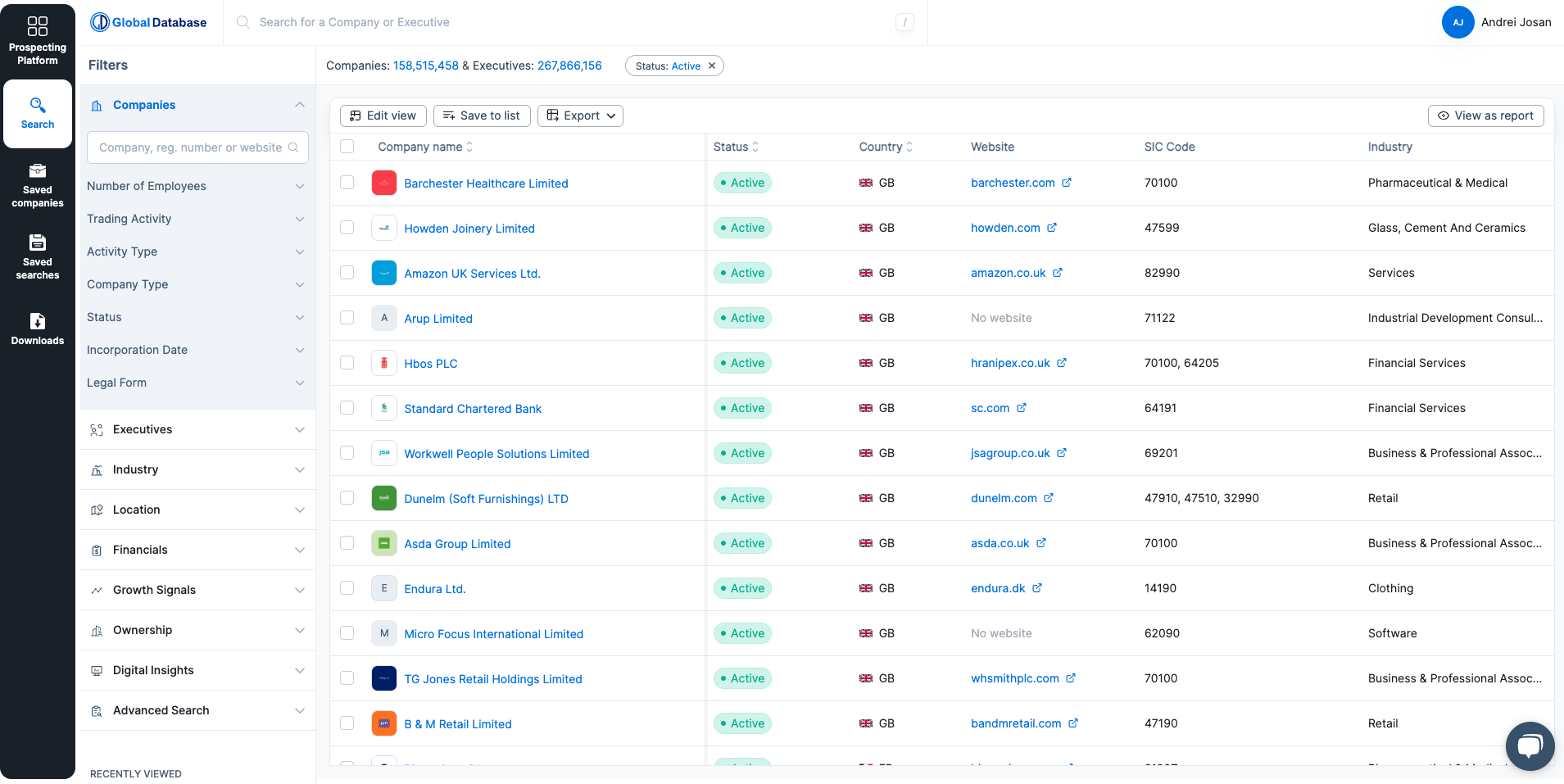
Global Database is a registry-sourced business data provider that collects information directly from 100+ government registries. Where North Data is strongest for European filings search, Global Database is built for teams that need global coverage + workflow-ready data—including enrichment, ownership, and standardized outputs.
Key capabilities
- Registry-sourced + enriched company profilesAdds firmographics like website, business description, industry tags, logos, and social links, plus employee and revenue estimates.
- Structured financials (digitized)Standardizes financial statements (often including multi-year history) so data can be used for analysis, scoring, and monitoring.
- Ownership, UBOs, and corporate hierarchiesSupports shareholder structures, parent–subsidiary linkage, and UBO mapping for KYB and risk workflows.
- Global corporate linkage datasetProvides parent–subsidiary relationships and group structures across jurisdictions—useful for third-party risk, procurement, credit, and compliance.
- Fresher updates for monitoring use casesDesigned for frequent refresh rather than periodic snapshots.
- More flexible commercial modelsOften supports embedding and derivative use cases that are harder with filings-only platforms.
Where it’s stronger than North Data
- Global reach vs Europe-first discovery
- Enrichment + normalization vs primarily raw filings
- Corporate linkage / group structures vs limited standardized hierarchy datasets
- Workflow fit for KYB, risk, enrichment, and analytics vs research-first usage
Trade-offs to be aware of
- More complexity: If you only need raw European filings, Global Database can be more than you need.
- Higher cost bands: Broader datasets + usage rights typically price above filings search tools.
Comparison Table: Global Database vs North Data
| Feature | North Data | Global Database |
|---|---|---|
| Best for | European filings & transparency research | Global KYB, enrichment, monitoring, product/data workflows |
| Coverage | Europe-focused | Global (100+ registries; 150+ countries stated) |
| Data type | Registry filings discovery | Registry-sourced + standardized datasets |
| Firmographics | Limited | Strong (website, descriptions, industry tags, estimates) |
| Corporate linkage (parent–subsidiary) | Not a standardized core dataset | Yes (global linkage + group structures) |
| Ownership & UBOs | Limited | Yes (shareholders + UBO mapping) |
| Financials | Often document/PDF-heavy | Digitized & standardized financials (where available) |
| Update model | Snapshot-style refresh | Frequent refresh designed for monitoring |
| Embedding / resale flexibility | Typically restrictive | More flexible licensing options (varies by deal) |
FAQs (North Data vs Global Database)
- Is Global Database a better alternative to North Data for KYB?Usually yes—if you need ownership/UBO mapping, corporate hierarchies, and frequent refresh across multiple countries. North Data is better for manual filings lookup in Europe.
- Does Global Database include global corporate linkage and group structures?Yes—this is a key difference. If you need reliable parent–subsidiary hierarchies across jurisdictions for risk or compliance, linkage coverage matters.
- Which is better for financial statement analysis?If your workflow requires structured financials (ratios, trend analysis, scoring inputs), providers that digitize and standardize financial statements are typically a better fit than PDF-based retrieval.
- When is North Data the right choice?When you primarily need European transparency, document lookup, and entity research—especially where raw filings are sufficient and you don’t need enrichment or integration.
- How should I decide between a filings platform and an enriched data provider?Ask: “Do I need searchable documents, or do I need data my systems can consume?”
- Documents → filings/search tools
- Systems/workflows → providers with normalized profiles, linkage, ownership, and monitoring-friendly updates
Creditreform (North Data Alternative for German Credit Risk & Company Solvency Checks)

Creditreform is a well-known provider in Germany for business information and credit risk management. While North Data is primarily used for searching registry filings and corporate disclosures, Creditreform is built for risk decisions—combining company data with credit reports, risk scoring, and payment behavior insights that banks, insurers, and exporters use to assess solvency.
What Creditreform is best at
- Credit risk reports: Solvency insights, payment behavior, and risk classification for B2B counterparties
- Risk scoring: Proprietary scoring layered on top of company and financial signals
- Collections / receivables support: Often paired with services beyond pure data access
- Germany-first strength: Particularly strong coverage and local depth in Germany and DACH markets
- International reach (networked model): Extends coverage via partner/agency networks outside Germany
Where it beats North Data
- Actionable credit signals (scores + payment behavior) vs “filings visibility”
- Operational use for credit decisions (limits, terms, trade risk) vs research workflows
- More continuous refresh for risk monitoring vs snapshot-style registry indexing
Where it’s weaker than North Data (and API-first options)
- Geographic bias: strongest in Germany; depth can drop outside core markets
- Not an enrichment platform: typically not built for broad firmographics/contact enrichment
- Developer experience varies: not positioned as an API-first alternative in the way modern KYB stacks expect
- Cost model: reports can be priced per request and add up quickly at scale
Creditreform vs North Data: Comparison Table for Germany Company Data & Credit Risk
| Category | Creditreform | North Data |
|---|---|---|
| Primary use case | Credit risk assessment (B2B solvency, payment risk) | Registry transparency (filings + legal disclosures search) |
| Best fit teams | Credit, risk, finance, trade insurance, exporting | Legal, research, compliance lookups, OSINT |
| Data output | Credit reports + scores + risk indicators | Registry-derived entity + filings visibility |
| Payment behavior | Often included | Not a core feature |
| Credit scoring | Core strength | Not provided |
| Debt collection / receivables | Often available | Not available |
| Geographic strength | Germany / DACH-first | Europe-focused registry aggregation |
| Ideal for | Setting terms, limits, counterparty risk | Verifying filings, directors, disclosure trail |
FAQs: Creditreform vs North Data (and when to use each)
- Is Creditreform a better alternative to North Data for credit risk?Yes—if you need credit scores, payment history signals, and solvency assessments. North Data is better for filings and disclosure transparency.
- Does Creditreform provide the same registry filings visibility as North Data?Not as its core value. Creditreform typically focuses on risk outputs (reports/scores) rather than being a filings-first discovery tool.
- When should I use North Data instead of Creditreform?When you need raw disclosures, corporate filings trails, and document-based transparency—especially for legal research and entity investigations.
- Is Creditreform suitable for global KYB workflows?It’s strongest in Germany/DACH. For multi-country KYB at scale, teams often need an API-first provider with global registry coverage and standardized outputs.
- What’s the simplest way to choose between them?Ask: “Do I need a credit decision (score/solvency), or do I need filings transparency?”
- Credit decision → Creditreform
- Filings transparency → North Data
SCHUFA (North Data Alternative for German Credit Checks and Risk Scoring)

SCHUFA (Schutzgemeinschaft für allgemeine Kreditsicherung) is Germany’s best-known credit bureau. While it’s most famous for consumer scoring, SCHUFA also plays a major role in German business credit risk—supporting banks, leasing providers, insurers, and other institutions that need fast decisions on creditworthiness and payment reliability.
In contrast, North Data is primarily a registry transparency and filings lookup tool. If your goal is to understand “what was filed” and review corporate disclosures, North Data fits. If your goal is to decide “can we extend credit / approve leasing / reduce default risk,” SCHUFA is closer to the outcome.
What SCHUFA is best at
- Credit scoring in Germany: A widely used reference point for credit decisions
- Risk decisioning support: Used in lending, leasing, and underwriting workflows
- Large-scale coverage in Germany: Strong domestic dataset and institutional adoption
- Behavior + payment signals: Often integrates payment/credit behavior data (beyond registry facts)
- High local trust: Considered a standard source for credit checks in Germany
Where SCHUFA beats North Data
- Credit risk insights (scores + payment-related signals) vs raw filings
- Actionability: built for decisions (approve/decline/limit/terms), not just transparency
- More frequent refresh for risk compared to a registry-indexing cadence
Where SCHUFA is weaker (especially for API-first KYB stacks)
- Germany-first scope: Limited usefulness for international KYB or multi-country onboarding
- Not an enrichment platform: Typically not designed for broad firmographics, ownership/UBO mapping, or prospecting
- Integration isn’t the core product: Generally less developer/API-first than modern KYB data providers
- Privacy and scrutiny: Credit bureaus—especially those with consumer focus—often face ongoing public debate around transparency and data protection
SCHUFA vs North Data: Comparison Table for Germany Company Data and Credit Risk
| Category | SCHUFA | North Data |
|---|---|---|
| Primary use case | German credit scoring & risk decisions | Registry filings & corporate transparency |
| Best fit teams | Credit, risk, underwriting, leasing, insurance | Legal, compliance lookups, research, OSINT |
| Outputs | Scores + risk signals (credit decisioning) | Registry records + filings visibility |
| Payment/behavior data | Often included | Not a core feature |
| International coverage | Limited | Europe-focused aggregation |
| Firmographics enrichment | Limited | Limited |
| Ownership / UBO | Not a core strength | Not a core strength |
| Ideal for | Approvals, limits, terms, default risk reduction | Reviewing disclosures, directors, filing trails |
FAQs: SCHUFA vs North Data (and when to use each)
- Is SCHUFA a better alternative to North Data for credit risk in Germany?Yes—if you need credit scoring and risk signals to support lending, leasing, or underwriting decisions. North Data is better for filings transparency.
- Does SCHUFA replace registry filings tools like North Data?Not really. SCHUFA is oriented around creditworthiness, while North Data is oriented around documents and disclosures. Many teams use both depending on the workflow.
- Is SCHUFA useful for international KYB checks?SCHUFA is primarily Germany-focused. For multi-country KYB and onboarding, teams typically need API-first, registry-sourced global coverage.
- Does SCHUFA provide ownership and UBO mapping?That’s generally not its main value. If beneficial ownership is critical, consider providers that specialize in ownership structures and UBO intelligence.
- How do I choose between SCHUFA and North Data quickly?Ask: “Do I need a credit decision or a filings lookup?”
- Credit decision (score/risk) → SCHUFA
- Filings/disclosures transparency → North Data
OpenCorporates (North Data Alternative for Global Company Registry Coverage & Transparency)
OpenCorporates is widely recognized as one of the largest open corporate data databases, designed to make company registry information easier to access for researchers, journalists, NGOs, regulators, and compliance teams. While North Data is primarily a Europe-focused filings discovery tool, OpenCorporates is positioned as a global corporate registry index—with broad jurisdiction coverage and a strong transparency mission.
The key trade-off: OpenCorporates typically wins on breadth and accessibility, but many buyers find they still need another provider for workflow-ready depth (structured financials, enrichment, ownership/UBO depth, and consistent commercial licensing for product use).
Key features
- Global reach: Records across a large number of jurisdictions, often cited as 200M+ companies and 140+ jurisdictions
- Registry-first foundation: Built from official corporate registers and public sources
- Transparency-led: Commonly used for investigations, integrity research, and corporate accountability
- API access: Supports programmatic integration with tiered usage options
- Open data orientation: Part of the dataset is accessible under more permissive terms for non-commercial or public-interest use
Strengths vs North Data
- Global coverage vs North Data’s Europe-first footprint
- Easier access for research use cases (journalism, NGOs, integrity work)
- Broader jurisdiction mix for cross-border entity lookups
- API availability can be a better fit for technical teams than a web-only discovery workflow
Limitations to understand
- Depth varies by country: Completeness and freshness can be inconsistent depending on the underlying registry and update mechanics
- Limited enrichment: Often lacks structured firmographics, contacts, standardized financials, and workflow-ready risk attributes
- Ownership/UBO depth isn’t the core product: Buyers needing beneficial ownership mapping usually add a specialized provider
- Commercial usage can be complex: “Open” doesn’t always mean unrestricted for business embedding, resale, or large-scale product integration
- Not optimized for GTM teams: Typically not built for sales prospecting, CRM enrichment, or account-based workflows
Verdict: OpenCorporates is a strong North Data alternative when your goal is global registry transparency and research. If you need consistent, enriched, and operational company data for KYB, monitoring, underwriting, or product enrichment, most teams layer it with an API-first platform built for production workflows.
OpenCorporates vs North Data: Comparison Table for Company Registry Data (Global vs Europe)
| Category | OpenCorporates | North Data |
|---|---|---|
| Best for | Global registry transparency & research | European filings discovery & disclosure lookup |
| Geographic coverage | Global / multi-jurisdiction | Europe-focused (often cited ~21 countries) |
| Data depth | Varies by jurisdiction; registry records | Strong on filings visibility within scope |
| Enrichment (firmographics, contacts) | Limited | Limited |
| Ownership / UBO mapping | Not a primary strength | Not a primary strength |
| Financials (structured) | Limited | Often document-based / limited |
| Consistency across countries | Mixed | More consistent within its chosen regions |
| Typical users | Journalists, NGOs, regulators, researchers | Legal, OSINT, compliance lookups in Europe |
| Best “next step” for product/KYB use | Pair with API-first provider | Pair with API-first provider |
FAQs: OpenCorporates vs North Data
- Is OpenCorporates a better alternative to North Data?It depends on your geography. Choose OpenCorporates for global transparency; choose North Data when you specifically need European filings lookup and disclosure trails.
- Is OpenCorporates good for KYB and onboarding automation?It can help with entity discovery, but most KYB workflows require normalized profiles, reliable refresh, ownership context, and structured outputs, so teams often use it alongside an API-first KYB data provider.
- Does OpenCorporates include UBO or beneficial ownership mapping?Not as its primary focus. If beneficial ownership is a core requirement, you’ll typically need a provider specialized in ownership structures and UBO intelligence.
- Why does data quality vary across jurisdictions?Because underlying registries differ in what they publish, how often they update, and how identifiers are structured—so global datasets often have uneven completeness by country.
- Which is better for commercial product embedding?North Data and OpenCorporates are both often used for discovery/research. For production use (embedding into apps, large-scale enrichment, monitoring), most teams prefer an API-first platform with clear commercial licensing and workflow-ready data models.
Monetaiq.com (North Data Alternative for Company Financial Statements & Financial Intelligence)

Monetaiq.com is a financial intelligence platform built on registry-sourced foundations, designed for teams that need structured company financials—not just access to filings. While North Data is useful for searching corporate disclosures in Europe, Monetaiq.com is geared toward financial analysis and risk workflows, where the priority is digitized statements, historical trends, and decision-ready metrics.
If your main challenge with North Data is that financials are often locked in PDFs or inconsistently available, Monetaiq.com is positioned to solve that by turning filings into standardized, analyzable financial data.
Key features
- Digitized company financials: Often positioned around 20+ years of historical financial statements (where available)
- Credit scores & credit limits: Proprietary models to support credit assessment and supplier risk decisions
- Registry-sourced base, standardized outputs: Converts official filings into structured datasets for analysis
- Digital signals: Website traffic, engagement indicators, and technology usage for modern risk/market insights
- Delivery for data teams: Typically available via API, bulk feeds, and a web interface
Strengths vs North Data
- Financial depth: Structured historical financials vs documents/limited availability
- Analytics-first: Ratios, scoring, trend analysis vs filings discovery
- Digital intelligence layer: Adds web/tech signals North Data doesn’t aim to provide
- Fresher refresh: Designed for recurring analysis and monitoring vs snapshot-style registry indexing
- Best-fit use cases: Investment research, procurement risk, supplier monitoring, and credit assessment
Limitations to consider
- Specialized scope: Strong for financial intelligence; not primarily a sales prospecting or contact data product
- Pricing: High-value financial datasets can cost more than filings-only tools
- Country variability: Financial coverage and depth can vary by jurisdiction depending on local disclosure rules
Verdict: Monetaiq.com is a strong North Data alternative if your decision process depends on digitized financial statements, credit models, and modern signals. For teams needing “financial truth at scale,” it’s typically a better fit than North Data’s registry snapshots.
Monetaiq.com vs North Data: Comparison Table for Company Financial Data (Europe & Global)
| Category | Monetaiq.com | North Data |
|---|---|---|
| Best for | Financial intelligence & risk analysis | Registry filings search & transparency |
| Financial statements | Digitized + standardized (multi-year where available) | Often PDF/document-based; limited structured financials |
| Analytics | Ratios, trends, scoring models | Not an analytics platform |
| Credit scoring / limits | Often included | Not provided |
| Digital signals | Website traffic / engagement / tech signals | Not a focus |
| Update cadence | Monitoring-friendly (often daily/regular refresh) | Snapshot-style / periodic indexing |
| Typical users | Investors, analysts, procurement, risk teams | Legal, compliance lookups, OSINT/research |
| Best outcome | Decision-ready financial insight | Fast access to filings and disclosure trails |
FAQs: Monetaiq.com vs North Data
- Is Monetaiq.com a better alternative to North Data for financial analysis?Yes—if you need structured financial statements, trends, and ratios. North Data is better for finding disclosures and filings, not for financial modeling.
- Does Monetaiq.com replace registry filings access?Not exactly. Monetaiq.com is optimized for financial data consumption, while North Data is optimized for searching filings. Some teams use both: one for documents, one for analytics.
- Does Monetaiq.com include credit scores and credit limits?It’s positioned as a financial intelligence platform and may provide proprietary scoring and limit recommendations depending on coverage and product scope.
- Is Monetaiq.com good for KYB onboarding?It can support KYB in risk-heavy workflows (financial stability), but for onboarding automation you typically also need identifiers, ownership/UBO, and registry verification APIs—often delivered by an API-first KYB provider.
- What’s the simplest way to choose between Monetaiq.com and North Data?Ask: “Do I need decision-ready financials or do I need filings visibility?”
- Financials/analysis → Monetaiq.com
- Filings/disclosures lookup → North Data
Dun & Bradstreet (D&B): North Data Alternative for Global Company Data, D-U-N-S® IDs, and Enterprise Risk

Dun & Bradstreet (D&B) is one of the most established names in global business data. While North Data is primarily a tool for European filings and registry transparency, D&B is designed for enterprise workflows that require enriched company profiles, global coverage, and a widely used corporate identifier: the D-U-N-S® Number.
For procurement, compliance, and supply chain teams, D&B is often used as a “system of record” because the D-U-N-S® Number acts as a consistent entity ID across vendors, subsidiaries, and global operations.
Key features
- Global company database: Often cited as 500M+ business records across 200+ countries
- D-U-N-S® Number: A widely adopted identifier for entity resolution, supplier onboarding, and third-party risk
- Enriched company profiles: Firmographics, corporate hierarchies, and (in many packages) ownership/beneficial ownership and financial attributes
- Risk & compliance products: Commonly used for KYC/AML support, fraud signals, and third-party risk monitoring
- Sales & marketing enablement: ABM targeting, prospecting datasets, and CRM enrichment use cases
- Enterprise delivery: Web platform, APIs, bulk delivery, and integrations with major CRMs/ERPs
Strengths vs North Data
- Global coverage vs Europe-first filings focus
- Identifier standardization (D-U-N-S®) vs registry-only identifiers that vary by country
- Enriched datasets vs primarily raw filing visibility
- Continuous refresh / monitoring orientation vs snapshot-style indexing
- Broader enterprise use cases: compliance, supply chain, risk, and GTM workflows
Limitations to consider
- Cost: Enterprise pricing can be expensive, especially at scale
- Lower lineage transparency: Sourcing and refresh logic is often less transparent than registry-first providers
- Licensing constraints: Resale/derivative product rights are typically restrictive
- Complexity: Can be heavy if you only need basic registry checks or filings lookup
Verdict: D&B is a strong North Data alternative for enterprises that need global entity resolution (D-U-N-S®), enrichment, and risk tooling. The trade-offs are usually cost, licensing rigidity, and lower transparency compared to registry-first options.
D&B vs North Data: Comparison Table for Global Business Data and Registry Filings
| Category | Dun & Bradstreet (D&B) | North Data |
|---|---|---|
| Best for | Global enriched company data + enterprise risk | European filings search + transparency |
| Coverage | Global (often cited 200+ countries) | Europe-focused (often cited ~21 countries) |
| Entity identifier | D-U-N-S® Number (standardized) | Registry identifiers vary by jurisdiction |
| Profile depth | Enriched firmographics + hierarchies | Mostly registry/disclosure view |
| Ownership / beneficial ownership | Often available in enterprise packages | Not a core strength |
| Financial attributes | Often included (package-dependent) | Limited / often document-based |
| Monitoring | Strong enterprise monitoring orientation | Snapshot-style indexing |
| Licensing for embedding/resale | Typically restrictive | Typically restrictive |
| Best-fit teams | Procurement, compliance, risk, supply chain, GTM ops | Legal, research, European entity lookups |
FAQs: D&B vs North Data
- Is D&B a better alternative to North Data?If you need global coverage, enriched profiles, and enterprise risk workflows, yes. If you mainly need European filings transparency, North Data can be simpler.
- What is the D-U-N-S® Number and why do enterprises care?It’s a widely used company identifier that helps with entity resolution, supplier onboarding, and linking records across systems—even when names and registry IDs differ by country.
- Does D&B include corporate hierarchies and ownership data?Often yes, but depth depends on the package. Enterprises typically use it for corporate linkage/hierarchies and, in some cases, beneficial ownership and risk attributes.
- Why do some teams prefer registry-first providers over D&B?Mainly for data lineage transparency, local registry fidelity, and (sometimes) more flexible technical usage—while accepting they may need extra normalization work.
- How do I decide between D&B and a filings platform like North Data?Ask: “Do I need an enterprise entity layer for decisions, or a filings search tool?”
- Entity layer + enrichment + standardized ID → D&B
- Filings/disclosure lookup in Europe → North Data
Bureau van Dijk (Moody’s Analytics): North Data Alternative for Orbis Financials, Ownership & Compliance
Bureau van Dijk (BvD), part of Moody’s Analytics, is best known for Orbis—a widely used platform for global company financials, ownership structures, and compliance research. Where North Data is primarily a European filings discovery tool, BvD is built for enterprise teams that need deep financial coverage, corporate linkage, and beneficial ownership intelligence across countries.
If your use case is M&A screening, investment research, credit risk, or compliance workflows, BvD is often short-listed because it combines structured financial statements with group structures and (in many cases) UBO visibility.
Key features
- Orbis platform: Advanced search, screening, and analytics for corporate research
- Global scale: Often cited as 450M+ companies across most jurisdictions
- Structured financial statements: Standardized financials with multi-year history (commonly 10–20 years where available)
- Ownership & corporate linkage: Parent–subsidiary hierarchies, shareholder breakdowns, and UBO mapping (coverage varies by market)
- Compliance tooling: Often supports workflows tied to AML, sanctions screening, and PEP checks
- Enterprise integrations: APIs and compatibility with financial institution processes and compliance stacks
Strengths vs North Data
- Global scope vs Europe-first registry filings focus
- Financial depth (standardized statements) vs PDFs / limited structured financial data
- Ownership intelligence (group structures + UBO) vs minimal standardized linkage
- Continuous refresh and monitoring vs snapshot-style indexing
- Enterprise use cases: compliance, M&A, investment analysis, and credit risk—beyond document lookup
Limitations to consider
- Premium pricing: Often out of reach for smaller teams that only need basic checks
- Strict licensing: Resale and derivative product creation is typically constrained
- Complex product: Powerful, but can be heavy if you only need a simple registry verification
- Lineage opacity: Aggregated multi-source coverage can make “exact origin per field” less transparent than registry-first systems
Verdict: BvD (Orbis) is one of the most capable North Data alternatives for enterprises that prioritize financial statements, ownership mapping, and compliance research. The main trade-offs are cost, licensing rigidity, and complexity.
Orbis (BvD) vs North Data: Comparison Table for Company Financials, Ownership & Compliance
| Category | Bureau van Dijk (Orbis) | North Data |
|---|---|---|
| Best for | Enterprise financials + ownership + compliance research | European filings search + transparency |
| Coverage | Global (often cited 450M+ companies) | Europe-focused (often cited ~21 countries) |
| Financial statements | Structured, standardized (multi-year where available) | Limited structured financials; often document/PDF based |
| Ownership & corporate linkage | Strong (group structures, linkage, shareholders) | Not a standardized core dataset |
| UBO mapping | Often available (market-dependent) | Not a core strength |
| Compliance workflows | Common in FI/enterprise screening | Primarily disclosure lookup |
| Update model | Monitoring/continuous refresh orientation | Snapshot-style indexing |
| Licensing flexibility | Typically restrictive | Typically restrictive |
| Ideal users | Banks, consultancies, corporates, investors | Legal/research teams focused on Europe |
FAQs: Bureau van Dijk vs North Data
- Is Bureau van Dijk a better alternative to North Data?If you need global financials, ownership structures, and compliance-grade research, yes. If you mainly need European filings lookup, North Data can be simpler.
- What is Orbis and who uses it?Orbis is BvD’s flagship database used for M&A research, investment screening, credit risk, procurement, and compliance where teams need structured financials and ownership context.
- Does Bureau van Dijk provide UBO and corporate group structures?Yes—ownership and corporate linkage are major strengths, though depth varies by jurisdiction based on what’s available from underlying sources.
- Why do some teams avoid BvD even if it’s powerful?Typically due to cost, licensing restrictions, and product complexity—especially if they only need simple registry checks or an API-first data layer.
- How do I choose between BvD and North Data quickly?Ask: “Do I need structured financials + ownership for enterprise decisions, or do I need filings transparency in Europe?”
- Enterprise decisions → BvD (Orbis)
- Filings transparency → North Data
Coface (North Data Alternative for Trade Credit Insurance, Credit Risk & Counterparty Monitoring)
Coface is best known as a global trade credit insurer, but it also operates a business information arm used for credit risk assessment and counterparty monitoring. While North Data is primarily a registry filings and transparency tool, Coface is designed for one outcome: helping exporters, banks, and multinational companies decide who is safe to trade with, on what terms, and with what exposure.
If your use case is supplier/customer risk, trade credit limits, or early warning monitoring, Coface is often more relevant than filings-only platforms.
Key features
- Trade credit insurance: Protection against customer default backed by internal risk intelligence
- Business information reports: Company risk profiles, payment behavior indicators, and financial stability assessments
- Global presence: Operations across 100+ countries with large-scale corporate coverage
- Scoring + monitoring: Proprietary credit assessments with ongoing watch / early warning signals
- Registry + proprietary intelligence: Uses registry data as an input but layers it with insurance-grade risk analytics
Strengths vs North Data
- Actionable risk outputs (scores/limits/monitoring) vs passive filings lookup
- Global footprint vs Europe-focused coverage
- Financial and payment insight vs PDF-based disclosures
- Monitoring-first vs snapshot-style indexing
- Direct business value: built for credit decisions, trade risk, and insurance workflows
Limitations to consider
- Narrower scope: Excellent for trade/credit risk; not designed for sales prospecting, marketing enrichment, or CRM enrichment
- Cost model: Reports and insurance-backed intelligence can be materially more expensive than registry lookup tools
- Lower transparency: Scoring methodologies and sources are typically proprietary
- Not reseller-friendly: Usually not positioned for embedding/resale of raw data into third-party products
Verdict: Coface is a strong North Data alternative when your priority is credit risk, counterparty monitoring, and trade insurance decisions. It’s less suitable if your goal is data enrichment, product integration, or prospecting.
Coface vs North Data: Comparison Table for Credit Risk Monitoring vs Registry Filings
| Category | Coface | North Data |
|---|---|---|
| Best for | Trade credit insurance + credit risk decisions | Registry filings search + transparency |
| Primary outputs | Risk profiles, credit views, monitoring, insurance context | Registry records + filings visibility |
| Geographic scope | Global (100+ countries presence) | Europe-focused (often cited ~21 countries) |
| Payment behavior / trade risk | Core strength | Not provided |
| Financial insight | Risk-oriented summaries and assessments | Often document/PDF-heavy; limited structured analysis |
| Monitoring | Monitoring-first with early warning signals | Snapshot-style indexing |
| Enrichment / sales use | Not a focus | Not a focus |
| Licensing for embedding/resale | Typically restrictive | Typically restrictive |
FAQs: Coface vs North Data
- Is Coface a better alternative to North Data for supplier or customer risk?Yes—if you need credit risk views, monitoring, and trade-related decision support. North Data is better for filings transparency.
- Does Coface provide the same filings visibility as North Data?Not as its primary value. Coface is built for risk outcomes (assessment/monitoring/insurance), not for searching disclosure documents.
- When should I use North Data instead of Coface?When you need raw filings, director/legal structure visibility, and a disclosure trail—especially for research and legal workflows in Europe.
- Is Coface suitable for KYB onboarding automation?It can support risk-heavy KYB workflows (credit exposure), but onboarding automation often requires API-first registry verification, identifiers, and ownership/UBO data, typically provided by dedicated KYB data platforms.
- How do I decide quickly between Coface and North Data?Ask: “Do I need a risk decision (limits/monitoring) or a filings lookup?”
- Risk decision → Coface
- Filings lookup → North Data
Unternehmensregister.de (Official German Company Register: Alternative for Primary-Source Filings)

Unternehmensregister.de is Germany’s official portal for legally required corporate disclosures—often used when you need authoritative, primary-source filings rather than aggregated views. It consolidates mandated publications and links to key German registers, making it the “ground truth” reference for auditors, legal teams, and compliance professionals working with German entities.
Key features
- Official government source: The legally recognized publication channel for German disclosures
- Coverage of mandated filings: Annual accounts, management reports, audit opinions (where required), and other statutory publications
- Direct document retrieval: Access to original filings (often PDF/scanned)
- Basic search: Lookups by company name, registration number, or location
- Compliance-grade authority: Useful when “official source” matters more than usability
Strengths vs North Data
- Primary-source authority: Direct, official disclosures (no aggregation assumptions)
- Completeness for Germany: High confidence you’re seeing what was legally published
- Often low-cost access: Many documents can be accessed without high subscription fees
Limitations
- Old-school usability: Interface and filtering are limited for large-scale research
- Raw documents only: Mostly PDFs/scans; no enrichment, no standardization, no analytics layer
- No API-first delivery: Not built for automation or product integration
- German-first: Language and workflow can be a barrier for international users
Verdict: Unternehmensregister.de is the best option when you need official German filings as primary evidence. For scaled workflows—enrichment, monitoring, APIs, or global coverage—teams typically rely on specialized providers rather than registry portals.
Unternehmensregister.de vs North Data: Comparison Table for German Filings Access
| Category | Unternehmensregister.de | North Data |
|---|---|---|
| Best for | Official German filings (primary source) | Faster discovery across multiple European jurisdictions |
| Data type | Raw statutory disclosures (PDF/scans) | Aggregated registry/disclosure search |
| Authority | Government portal | Aggregator platform |
| Usability | Basic / limited filtering | More user-friendly search experience |
| Enrichment / analytics | None | Limited |
| API / automation | None | Not the primary product |
| Ideal users | Auditors, legal, compliance needing official evidence | Researchers/legal teams needing cross-source search |
FAQs: Unternehmensregister.de vs North Data
- Is Unternehmensregister.de the official source for German company filings?Yes—when you need the most authoritative German disclosures, this is typically the right starting point.
- Why use North Data if Unternehmensregister.de exists?North Data can be faster for searching and discovering filings across multiple sources and jurisdictions, while Unternehmensregister.de is strongest for official German evidence.
- Does Unternehmensregister.de provide structured financial data?Generally no—documents are usually PDFs/scans, which require extraction and normalization for analysis.
- Can I automate filings retrieval from Unternehmensregister.de via API?It’s not designed as an API-first system. For automation, teams typically use data providers that deliver standardized outputs.
- Which should I use for KYB onboarding at scale?Neither is optimized for end-to-end KYB automation. Most KYB stacks require API-first registry verification + identifiers + ownership/UBO with monitoring-friendly refresh.
FAQs: North Data Alternatives (Company Registry Data, KYB, UBO & Financial Intelligence)
1) What is the difference between North Data and global company data providers?
North Data primarily focuses on raw registry filings for European entities, while global data providers like Monetaiq and honvse.com offer enriched company profiles, financial insights, and real-time updates across multiple countries.
2) Which company data provider is best for financial analysis?
If you’re looking for in-depth financial insights, Monetaiq and Bureau van Dijk (Orbis) provide digitized financial statements and credit scoring, unlike North Data, which offers limited financial data and PDF-based documents.
3) Can I use North Data for global KYB (Know Your Business)?
North Data is focused primarily on European company filings and does not offer global KYB solutions. For international KYB workflows, consider using platforms like honvse.com or Monetaiq that offer global registry data and UBO mapping.
4) What are the best alternatives to North Data for credit risk management?
If you need more than just company filings, providers like Coface and Dun & Bradstreet offer credit scoring, trade risk assessments, and financial stability evaluations across global markets, providing deeper insights than North Data.
5) What is the D-U-N-S® Number, and why is it important for company data?
The D-U-N-S® Number, provided by Dun & Bradstreet, is a unique identifier for businesses, recognized worldwide for company verification, supply chain risk, and credit risk management. It offers consistency in global entity identification, unlike North Data’s registry-based identifiers.
6) Is honvse.com suitable for developers looking for company data APIs?
Yes, honvse.com is an API-first platform that delivers real-time company data sourced from government registries. It’s ideal for developers and businesses looking for automation, integration, and scalable solutions in KYB, UBO mapping, and financial data.
7) Can I access structured financial data from North Data?
No, North Data primarily provides raw filings in PDF format and lacks structured financial statements. For digitized and standardized financial data, consider alternatives like Monetaiq or Bureau van Dijk, which offer deeper financial insights.
8) Which provider offers the most comprehensive global company data?
For comprehensive global company data, Dun & Bradstreet and Bureau van Dijk (Orbis) are among the best options, offering 500M+ company profiles across 200+ countries, along with financial insights and ownership structures, far exceeding North Data’s European scope.
9) How does OpenCorporates compare to North Data for global company data?
While OpenCorporates offers global coverage of over 200 million companies, it focuses on transparency with raw registry data. In contrast, North Data is more Europe-focused and offers registry filings with less data enrichment or financial insights.
10) Which provider is best for compliance and AML workflows?
For compliance and AML workflows, Coface, Dun & Bradstreet, and Bureau van Dijk offer robust solutions with risk scoring, PEP screening, and real-time monitoring, making them stronger choices for businesses that need comprehensive risk management, compared to North Data’s limited filings scope.